
There’s something special—and something eerie—happening behind the scenes of human behavior every time you open your phone before your feet even hit the floor in the morning.
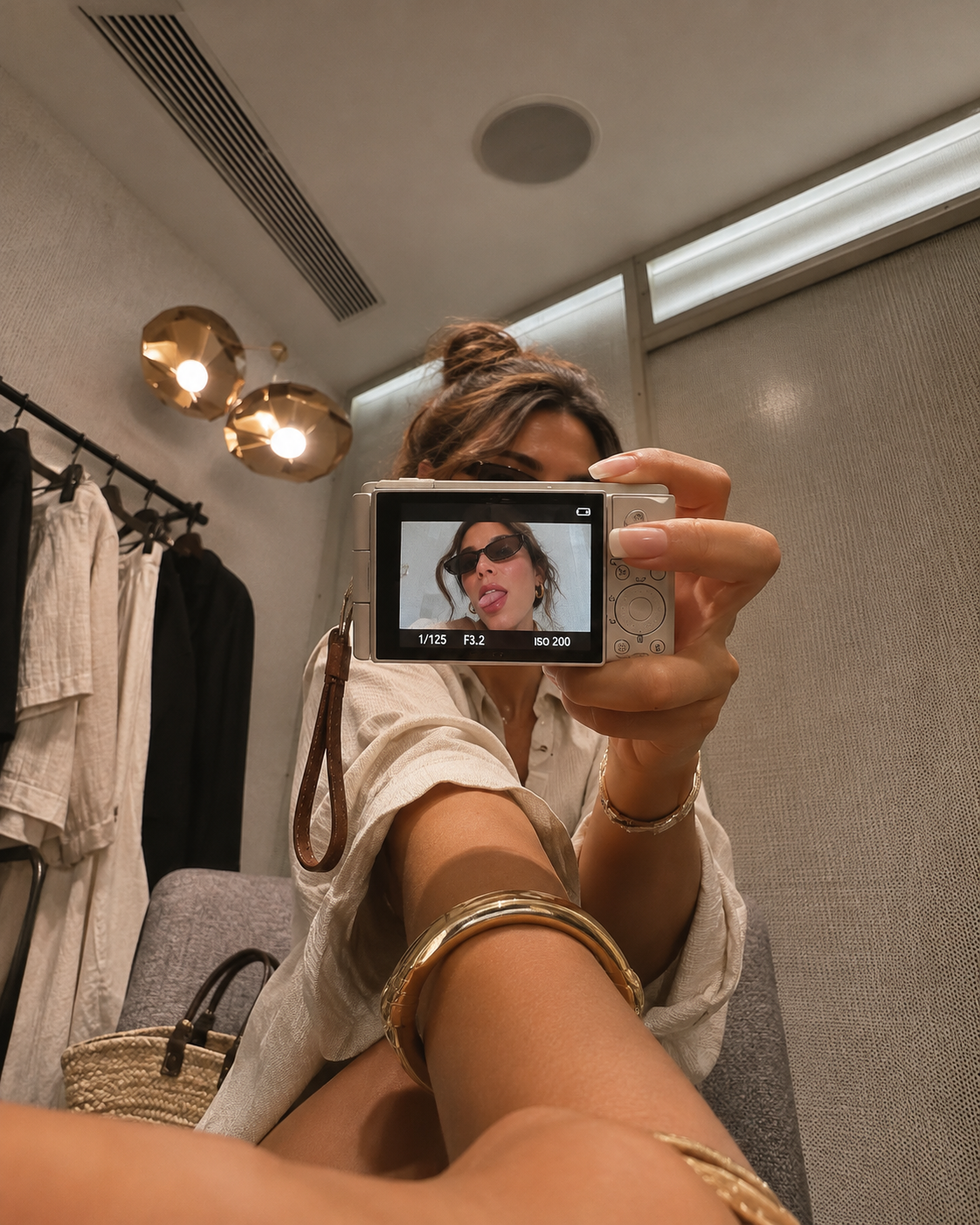
source: tatiana vitas
Last Tuesday I was in bed at 6am, one kid already in my ear for an egg sandwich, and I had a $54 serum in my cart. I don’t even have a skincare routine. But there I was, rising with the sun, and forty-five minutes of scrolling later, I’d added things to a cart with the conviction that I’d done some extensive research, when really I’ve just absorbed the confident opinions of a 24-year-old I’ll never meet.
Meanwhile, my mom, who has worked in skincare for years—and has known me since before I had a personality, tells me not to buy that lousy serum. But I roll my eyes like she just insulted my intelligence. She literally does this for a living.
This psychological chaos is worth understanding because it’s seeping into how we move through our own lives. The TikTok stranger has no effect on our lives, and that’s exactly why we trust them.
The people who love us come loaded with context.
They remember everything about you. About me. My sister remembers the time I impulse-bought a Peloton back in 2019. It’s now almost 2027 and it’s a coat rack at this point. The people who love us know our patterns. It means their advice is filtered through us specifically. They know our history. Our weaknesses. Our tendency to catastrophize or our habit of ignoring red flags until they’re on fire.
That type of context, which in reality should make their advice more valuable, is exactly what makes us discount it. It feels like a personal attack. Like a judgment masquerading as concern.
A stranger online doesn’t come with any of that baggage. They don’t know I cheated on my math Regents back in the day or that I’m eating coconut chocolates in bed at 11pm. These strangers are a clean, neutral source—someone with no motive except, allegedly, wanting to help. Of course they’d never recommend something just because they’re paid to.
In 1962, psychologists Elaine Walster and Leon Festinger found that people were more swayed by a message when they thought they’d just overheard it, when nobody seemed to be trying to persuade them. Sixty years later, that’s a business model. People extend their trust to sources who come off as disinterested, even when those sources are, in fact, very interested. The 24-year-old with the serum isn’t selling you anything. She’s just talking. In a bathroom. With a ring light and an affiliate link.
We’ve gotten to this strange place where we let a total stranger’s opinion, paired with zero accountability and zero knowledge of our actual life, outweigh the input of someone who has watched us live it.
The more we see something, the more we’re more inclined to make the purchase. It’s the repetition doing the persuading, not the actual truth.
There’s a well-documented effect where the more we’re exposed to something, the more true or trustworthy it starts to feel—regardless of whether it actually is. This is why nobody needs to technically convince you the jacket is worth it. You just need to scroll through your feed and let the algorithm show you the jacket eleven times in one afternoon, worn by eleven different people who all seem to love it, and your brain reclassifies it from a ‘random purchase’ to ‘I need this right now.’
Your close friend telling you something once, with actual reasoning attached, can’t compete with an algorithm repeating a vaguer, flashier version of the same message fifty times a day. Frequency is being mistaken for consensus, and consensus is being mistaken for truth.
And then somewhere in your TikTok feed, these strangers stop feeling like strangers anymore. I’ve watched women on TikTok get married, have babies, get divorced, renovate kitchens, and cry in their cars. I know what their bathrooms look like. I know their coffee orders. Some of them have shared more details about their lives with me than my actual neighbors have.
Psychologists call these one-sided connections parasocial relationships. We create this sense of familiarity with people who don’t know we exist. So when the girl with the ring light recommends a serum, it doesn’t always feel like an ad from a stranger. It feels like a recommendation from a friend in passing. Except she doesn’t know you. Or me. She couldn’t pick me out of a lineup.
Social proof from strangers now hits harder than expertise from people who know you.
I felt this firsthand. Someone close to me was pregnant and asking me which prenatal vitamins I used. I have three kids. I think I’m a pretty good source to ask advice from. I gave her my recommendation, only to find out she went with a Tiktoker’s choice. I told her that one is filled with junk, will make your belly hurt, and is literally a ‘trending’ brand. She didn’t care. Until a month later she switched to the one I used.
We are, as a species, wired to look around and copy what everyone else seems to be doing. It’s an old survival instinct that used to be useful for things like ‘don’t eat those berries’, now translating to ‘buy this $60 candle.’ When a stranger online says ‘everyone is doing this,’ it activates that same instinct, even though ‘everyone’ is a curated slice of people who were also shown the same advertisement.
Compare that to your friend saying: I don’t think you should do this, which activates nothing except mild defensiveness, because one person’s judgment doesn’t feel like social proof of anything—it just feels like an obstacle between you and the thing you already half-decided to do before you opened the app.
But of course! Of course, there’s a flaw in my argument. The people who know us best aren’t always right either.
Our parents can be stuck on this outdated version of us. Our closest friends can mistake their own fears for good advice. And sometimes a stranger on the internet really does know more about something than the people sitting around our dinner table.
But all that doesn’t really bother me. It’s that we’ve started confusing visibility with credibility. A stranger being repeatedly put in front of my screen begins to feel like evidence that they’re worth listening to. But it’s simply an annoying social media feature I never opt into to scan my data and feed me things related to what I click on.
Maybe the problem isn’t whether we should trust strangers or even the people we love. Maybe we’ve just become so accustomed to being told what to think that we’ve stopped asking why we believe it.
The more unsettling question is when this same pattern starts dictating actual life decisions. Who we date, how we parent, whether we leave a job, or a relationship—based on a stranger’s 60-second monologue, while my sister watched me waste money, and my mom watched me repeat a mistake, both get treated as background noise. The influencer online doesn’t watch you do anything.
We’ve outsourced our gut instincts to volume. Not because strangers are smarter, but because they’re easier. No history. No accountability. No risk of being told something we don’t want to hear by someone who will still be there tomorrow.
Like my sister. Texting me that my new idea was a bad idea. I ignored her. But she still texted me the next day anyway. That’s the whole point.
